

Booked Out Before the Opening Ceremony: QLD's 2032 Accommodation Problem
Acure Asset Management provides in-house research, analysis and news bulletins to subscribers on a monthly basis.
Our reports are based on Australian Property and Market trends as they happen – as well as reflective reports on our portfolio and performance.
Subscribe for more tailored News and Insights from Acure Asset Management below or on our Contact page
Six years out from the Games, Queensland’s hotel pipeline is delivering roughly a quarter of what the state needs, and the gap is a feasibility problem, not a demand problem.
Brisbane’s hotel market is doing everything an investor would want it to do. Occupancy sits in the mid to high 70s, room rates grew faster in 2025 than almost anywhere else in the country, and the city has posted the strongest RevPAR growth of any major Australian market. Rates now sit well above pre-pandemic levels, a rare distinction shared with only a handful of markets nationally.
And yet almost nothing is being built.
The Property Council of Australia’s 2026 Queensland Hotels Outlook, prepared with CBRE, found that just one new hotel opened across Brisbane, the Gold Coast and the Sunshine Coast in the preceding twelve months. On a probability adjusted basis, the current pipeline is expected to deliver around 24% of the 14,700 additional rooms required by 2032, and roughly 9% of the state’s longer dated 40,000-room Destination 2045 target. Broader industry estimates put the South East Queensland shortfall as high as 30,000 rooms once the wider events calendar and Games-time officials, media and workforce accommodation are accounted for.
The Property Council’s framing is blunt, and worth repeating: the accommodation challenge is structural, not cyclical. Demand is arriving. The rooms are not.
Construction Costs: The Binding Constraint
Construction costs for three-to-five-star hotels have risen close to 40% since 2019, with CBRE forecasting a further 18% across 2026 and 2027 combined. Rider Levett Bucknall has Brisbane escalation running at around 5% for 2026 and lifting toward 7% from 2027 onwards as Olympic venues, transport works and the state’s health infrastructure program compete for the same trade base. Turner & Townsend’s global survey is more aggressive again, forecasting Brisbane escalation of 7.2% for 2026 against global construction inflation of roughly 4.5%.
Critically, this is not imported inflation. RLB’s own analysis attributes the bulk of escalation to domestic labour availability, contractor capacity and pipeline competition rather than global input shocks. That matters, because it means the pressure does not ease when freight and fuel normalise. It eases only when capacity is added or demand for that capacity falls away, and neither is likely before 2032.
The result is an all in delivery cost, including FF&E, of approximately $795,000 per key in Brisbane, against roughly $830,000 in Sydney and $772,000 in Melbourne. Nationally, only 2,339 hotel rooms were added in 2025, supply growth of 1.3%.
Apply the standard screening heuristic used in hotel development, that at around 65% occupancy a project needs roughly $1 of ADR for every $1,000 of cost per key and a $795,000 Brisbane build requires something close to a $795 average daily rate to stack up. Sydney, the highest rated market in the country, averaged $334 in 2025.
That is the gap. Not sentiment, not planning appetite, not capital availability. A revenue line that would need to roughly double before ground up CBD development clears its own cost of construction.
5-star versus 4-star: Where Feasibility Actually Sits
The cost differential between luxury and upper-upscale product is substantial and it compounds through the entire build. A 5-star guestroom typically runs 45–55 sqm against 28–35 sqm for a 4-star key, so the same envelope yields materially fewer revenue-generating rooms. Layer on the back of house and public area ratios luxury operators require; ballroom and MICE space, multiple F&B outlets, spa, expanded arrival sequence, higher staff to room ratios needing more BOH area – and gross floor area per key can be 50–70% higher before a single finish is specified. FF&E budgets, façade complexity, MEP loads and program duration all follow.
International benchmarking puts median luxury development cost at roughly two and a half times full service and four to five times select service on a per-key basis. Australian conditions compress that spread somewhat, but the direction is unambiguous: the higher the star rating, the further the required ADR travels beyond what the market currently supports.
4-star and upper-upscale product carries a structurally better feasibility profile for three reasons:
Lower capital intensity per key – smaller rooms, leaner public areas and a tighter FF&E spec bring the cost base closer to achievable rates.
Cheaper to operate – no 24-hour concierge, no fine dining program, no spa payroll. Margin protection matters more when financing costs are elevated.
Deeper demand base – Olympic Games and legacy demand from officials, media, corporate groups, sporting bodies and event attendees sits predominantly in the 4-star band, not the luxury band.
Which is not to say 5-star development stops. It says it stops as a standalone proposition. Where luxury is being delivered, it is being cross-subsidised, attached to an integrated resort, a residential component, a branded residence sell
down or a membership club. Queens Wharf is the local illustration: the 150 key Rosewood is delivered alongside the 387 key Dorsett, and neither would likely have proceeded as a solo tower.
For anyone underwriting new Queensland accommodation supply, that is the shape of the market. Luxury needs a subsidy. 4-star needs a site.
The Legacy Case is Stronger Than The Event Case
One further point deserves emphasis, because it is routinely missed in Games commentary.
CBRE’s analysis of six Olympic host cities since 1996 found median room night growth of 8.4% in the second year after the Games and 7.5% in the third, materially above the event year itself. The Games are a demand catalyst, not a demand peak. Sydney 2000 followed the same pattern.
Rooms sized only for a fortnight of competition in 2032 would be the wrong asset. Rooms underwritten against a decade of elevated post-Games visitation are a very different proposition and it is the segment discipline set out above that determines whether those rooms ever get built.
Acure Insight: Brisbane presents an unusually clean supply-demand dislocation. Occupancy and rate are at or near record levels, escalation is locking out new ground up supply, and the 2032 catalyst has a demonstrated tail well beyond the event window. In our view the near-term opportunity sits less in ground up luxury development, which requires a cross-subsidy most sites cannot provide, and more in existing 4-star and upper-upscale assets acquired below replacement cost, and in repositioning plays where refurbishment capital buys rate uplift at a fraction of new build economics. Every year escalation runs ahead of construction, the replacement cost argument for standing assets gets stronger.
Now Open For Investment: Palm Meadows Gold Coast Trust
Acure Asset Management is pleased to announce the launch of the Palm Meadows Gold Coast Trust, offering investors the opportunity to acquire a majority interest in the Mercure Gold Coast Resort at Carrara, Queensland – secured at a significant discount to replacement cost.
The Trust is seeking to raise $22.2 million to acquire the initial portfolio, with further acquisitions planned in year one to build a 75% ownership stake in the Resort.
The investment strategy centres on a significant refurbishment program to be undertaken by the Trustee in year one, positioned to enhance the Resort’s operating performance and drive long-term profitability in one of Australia’s strongest tourism markets.
The Gold Coast continues to benefit from record tourism demand, constrained new hotel supply and major infrastructure investment ahead of the Brisbane 2032 Olympic and Paralympic Games.
Key Investment Highlights
Majority ownership of an established Gold Coast resort asset
Acquisition at a significant (~60%) discount to replacement cost
Value-add refurbishment program commencing in year one
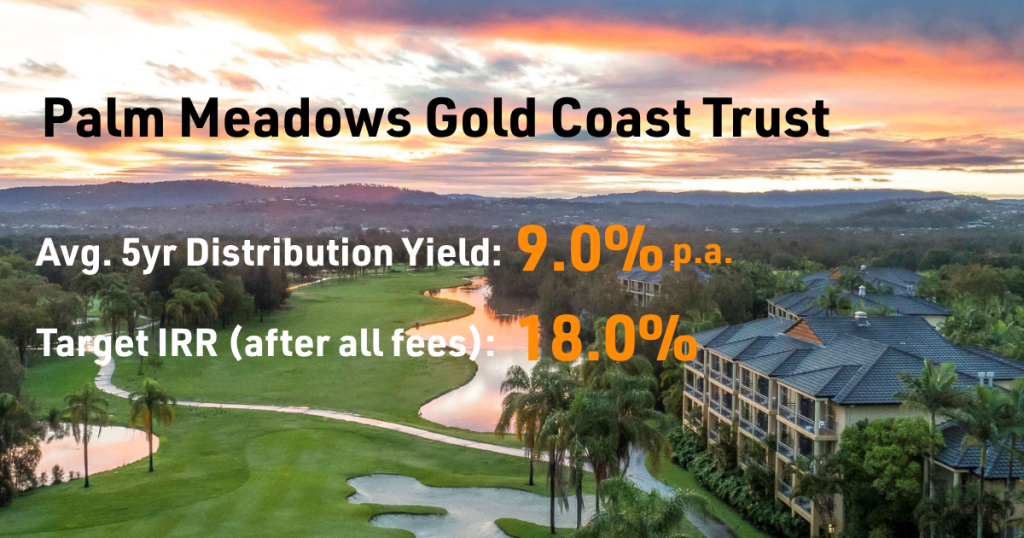
Target IRR of 18% per annum (after all fees and costs)
Forecast average 5-year distribution yield of 9.0% per annum, commencing in year two
How to Apply
You’re welcome to invest via either of the following options:
Manual application, refer to the below Information Memorandum (pages 40+)
Online investor portal, To access the portal, click the button below:
– James Del Borrello [email protected]